Garage Floor Epoxy Boise: built to take hot tires and dropped tools
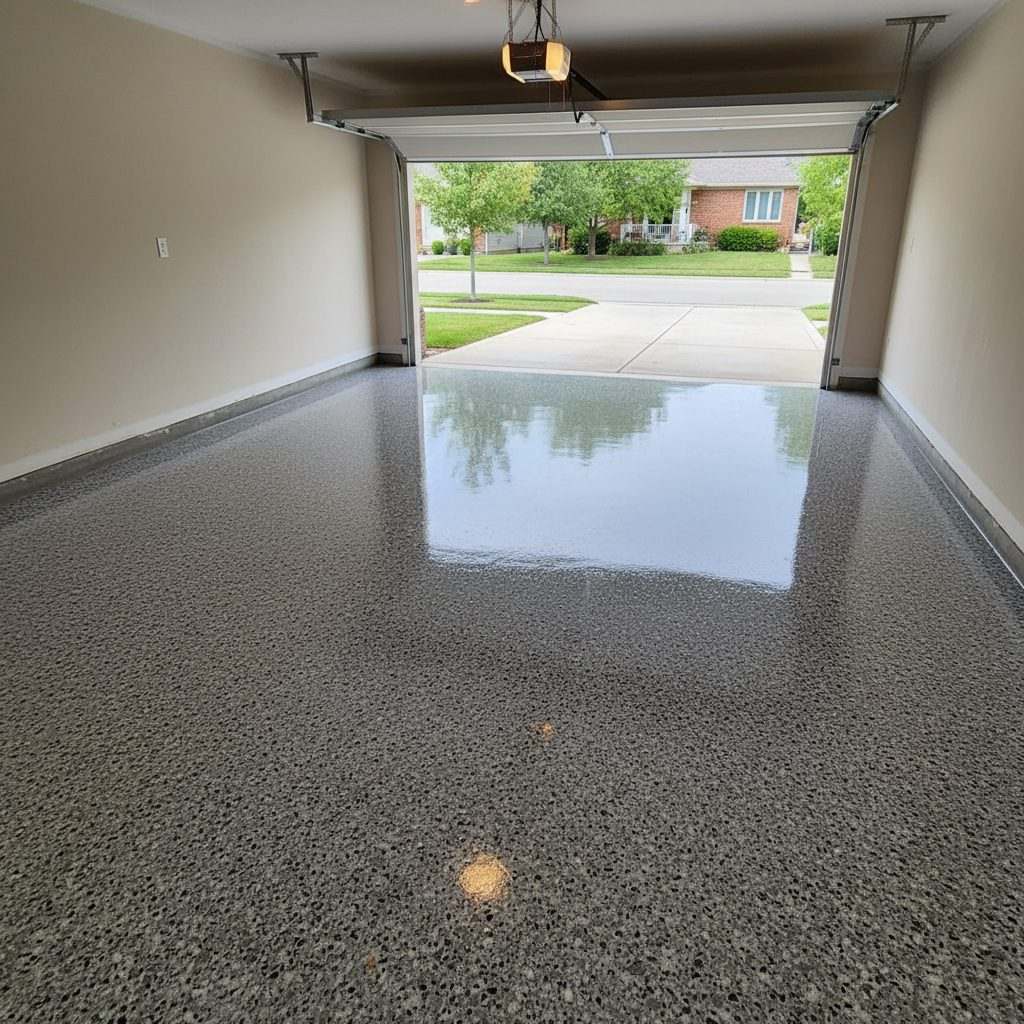
A bright, dust-free, easy-to-clean garage floor backed by a Lifetime Warranty.
You know that gray, oil-spotted slab you sweep around every Saturday? A couple of visits from our family crew and it is a bright, sealed floor you can squeegee clean in five minutes, backed by a lifetime warranty against peeling or lifting.
Why Garage Floor Epoxy Is the Best Upgrade for Boise and Treasure Valley Homeowners
A Boise garage floor works harder than most. Winter means the sand and magnesium-chloride brine the Ada County Highway District lays down on Federal Way, State Street, and the Connector gets tracked in on your tires and wheel wells, then dries into the slab. Summer means hot tires coming off asphalt that has been baking in high-desert sun, plus motor oil, chain lube, and whatever drips off the boat or side-by-side on the way back from Lucky Peak. Bare concrete drinks all of it in, and once a stain sets, no degreaser brings the slab back. A flake epoxy floor changes that: it seals the pores, gives you a hard non-porous surface that wipes clean, and turns a gray Bench or Northwest Boise slab into a floor that reflects light and makes the whole garage feel bigger.
With a professionally installed epoxy garage floor, you get:
- A clean, bright floor that won't soak up oil, chemicals, or road grime
- No more concrete dust settling on your tools, storage bins, and vehicles
- Better traction underfoot when the floor is wet or snowy
- A surface built to stand up to Boise's freeze-thaw cycles without chipping or peeling
- A finished, showroom look that makes the whole space feel bigger and cleaner
Beyond looks, epoxy significantly raises the utility of your garage. Whether you park daily drivers, store motorcycles and equipment, or use the space as a workshop, a sealed floor is easier to maintain, safer underfoot, and far more resistant to the kinds of damage that degrade bare concrete over time.
How to Get Your New Garage Floor in Boise
Getting started is simple. The whole project comes down to three easy steps:
- 1. Schedule a free in-garage estimate. Call us and we'll find a time that works for you. We view the floor, talk through your goals, and give you an estimate. No pressure to proceed.
- 2. Choose your color and finish. We bring physical samples to every estimate so you can pick the flake blend and topcoat sheen that fits your home, right there in your own garage lighting.
- 3. We put it on the calendar and get to work. Our own family crew handles everything, no employees and no subcontractors. Prep, repairs, and coating, all done by the same hands. You get the garage back as soon as the floor reaches full cure.
The Problem With Bare or Painted Concrete
Bare concrete is basically a hard sponge. One oil drip off the crankcase and the stain is in for good, no matter what degreaser the guy at the parts counter on Fairview swears by. That fine gray powder that keeps settling on your toolbox is the slab itself slowly wearing away under tires and foot traffic. Give it enough Idaho winters and you get hairline cracks, spalled patches, and a rough surface that holds dirt.
Garage paint is a step up, but a small one. Most of it is latex that dries on top of the concrete instead of bonding into it, so it peels, bubbles when moisture pushes up from below, and gives up fast under spills and abrasion. A good share of the Boise homeowners who call us rolled on a coat of paint a year or two ago and are watching it flake off in sheets.
How Epoxy Protects Against Idaho's Freeze-Thaw Cycles
Boise runs hot and dry in July and drops below freezing on plenty of January nights, and a garage slab feels both extremes because the door opens and closes all day. The spot that takes the worst of it is where your tires park. Drive home on a summer afternoon, tuck the truck in, and those hot tires sit on a cool coating for hours. On a cheap paint or a rushed kit that never bonded, the tire literally pulls the coating up when you back out the next morning. That is hot-tire pickup, and it is the number-one garage-floor failure we get called to fix in the Treasure Valley. Winter adds the other half: meltwater runs off the vehicle, pools near the door, seeps into any micro-crack, then freezes and pries the crack wider.
A properly built garage system beats both. Diamond-ground concrete lets a high-solids epoxy key deep into the slab so hot tires cannot lift it, and a UV-stable polyaspartic topcoat handles the temperature swing without yellowing or going brittle. We pay extra attention to the front two feet by the door and the driveway apron transition, since that is where meltwater and hot tires do the most damage on a Boise garage.
The Installation Process
Professional epoxy installation is a multi-step process. Every phase matters, and skipping any one of them is why DIY kits from the hardware store so often fail within a year.
- Surface Preparation: We grind the whole slab with diamond-cup grinders, which opens the pores of the concrete so the epoxy can penetrate and bond rather than just sitting on top. Oil-soaked spots and old coatings get extra grinding passes until we are down to clean, bare concrete. This step is what prevents peeling, hot-tire pickup, and premature failure. It is what separates professional results from DIY results, and our prep guide covers what you clear out beforehand and what can hold the day up.
- Crack and Spall Repair: Any existing cracks, chips, or low spots are filled and leveled before coating begins. You cannot coat over structural problems and expect a lasting result, and proper repair keeps those imperfections from telegraphing through your new coating.
- Base Coat Application: A high-solids epoxy base coat is rolled onto the prepared concrete at the correct spread rate. This layer bonds chemically to the concrete and forms the foundation of the system.
- Broadcast Flakes or Chips: While the base coat is still wet, decorative vinyl flakes or color chips are broadcast across the surface. This adds texture, hides minor imperfections, and gives the floor its distinctive finished appearance. Coverage can be full broadcast (complete coverage) or partial for a more subtle look.
- Topcoat: A clear polyaspartic or polyurethane topcoat is applied over the flake layer after it cures. The topcoat locks the flakes in place, provides UV stability so the floor does not yellow in sunlight, and gives the surface its final gloss or matte finish. This is what keeps your floor looking clear and bright instead of yellowing or chalking over time.
Got a Boise garage floor that needs help? Call for a free estimate.
Call (208) 285-7685What Does Garage Floor Epoxy Cost in Boise?
Most Boise two-car garages fall in a moderate investment range depending on square footage, the condition of the existing concrete, and the finish type selected. Three-car garages typically land in a higher range, and oversized or tandem garages are priced per square foot during the free estimate. These are real-world ranges based on jobs we run in the Treasure Valley, not national averages.
The biggest variables are concrete condition and repair scope. A slab that is relatively level and clean costs less to prepare than one with significant cracking, old paint, or embedded oil stains that require extra grinding passes. After we see your floor in person, we give you an estimate.
It is worth comparing that number to the real cost of a DIY kit. Most big-box epoxy kits run a few hundred dollars up front, but they routinely start peeling or lifting where hot tires sit within a year or two. Then you pay again to grind the whole floor off and start over. A professional system is built right the first time and backed by a lifetime warranty against peeling or lifting.
Why Not Just Use a DIY Epoxy Kit?
Big-box epoxy kits look cheaper on the shelf, but they rarely include the surface preparation and repair work a Boise garage slab actually needs. These are the most common DIY problems we get called in to fix:
- Peeling and hot-tire pickup because the concrete was never diamond-ground first, so the coating sat on top instead of bonding into the slab.
- Bubbling and yellowing from untested moisture pushing up through the slab and from non-UV-stable topcoats that discolor in sunlight.
- Thin, patchy coverage that still soaks up oil and road grime instead of truly sealing the concrete.
Here is how a professional install compares to a hardware-store kit, side by side:
Flake Epoxy vs. Solid-Color Epoxy: Which Is Right for You?
Two finishes cover almost every Boise garage. Here is how they stack up so you can decide before your estimate:
Who actually grinds and coats your Boise garage floor?
We are a Treasure Valley crew, not a national franchise that hands your slab to a rotating subcontractor. The people who price your garage are the same people who grind it, patch it, and coat it.
Boise garages are not all the same, and prep changes with the slab. A 1990s-and-newer garage out in Northwest Boise, Harris Ranch, or the Southeast foothills subdivisions usually has a clean, level slab that grinds fast. Older garages on the Bench, in the North End, or around the Vista neighborhood often carry decades of oil, past paint jobs, and settling cracks that need more grinding passes and crack repair before a coat should ever go down. We read your specific slab and set primer and topcoat thickness accordingly instead of running the same recipe on every floor. Slab temperature matters too, which is what when to epoxy a garage floor in Boise is about.
What to Expect on Installation Day
The crew will arrive at the agreed time with all equipment and materials. You do not need to supply anything. The garage should be cleared of vehicles, stored items, and wall-mounted accessories that hang close to the floor. Preparation and coating work creates some odor and dust, so we recommend keeping interior doors to the house closed during the job. A standard two-car garage runs prep and base coat, then the topcoat on a second visit once the base coat cures, usually the following day. You can normally walk on the floor once the final coat cures and park vehicles after the full cure window, depending on temperature and materials. We confirm the exact timing for your specific project.
How to Maintain Your Epoxy Floor
This is the easy part. Sweep out the winter sand when the season turns, and run a mop with mild soap and water over the floor when it needs it. Gasoline, brake fluid, and motor oil wipe up instead of soaking in, so a leaky project car is a paper-towel problem, not a permanent stain. The one real rule: skip harsh solvent cleaners, which can dull the topcoat over the years. Our epoxy floor cleaning and maintenance guide goes further into Treasure Valley road sand, deicer and hot-tire season.
Areas We Serve
We coat garage floors across Boise and the wider Treasure Valley, Meridian, Nampa, Eagle, Caldwell, Kuna, and Star. In Boise itself that runs from the North End and the East End up into the foothills, across the Bench and West Boise, and out through Northwest Boise and the Southeast subdivisions toward the county line. Whether it is a fresh builder slab or a worn floor that has seen thirty winters, odds are we have already done a garage nearby.
Ready to stop looking at a stained, dusty garage floor? Boise Epoxy Pros offers free, no-pressure estimates for homeowners throughout the Boise metro area. We show up on time, explain exactly what the job involves, and give you an estimate. Call us to get started.
Call (208) 285-7685 to Schedule Your Free EstimateGet Your Free Garage Floor Epoxy Estimate
No obligation, no pressure. We'll review your floor, explain your options, and put your free estimate.
Get your free, no-obligation estimate
Call (208) 285-7685 and describe your floor. You get a straight answer on what it takes, no form, no waiting.
Call (208) 285-7685Free estimate over the phone, no phone tree See your price30-second calculator on the home pageNo obligation.
Frequently Asked Questions
Explore Our Other Epoxy Services
Metallic Epoxy Flooring Boise
Premium hand-worked metallic pours with marbled, three-dimensional depth. The showpiece finish for showroom garages, man caves, and feature floors.
Learn MoreCommercial Epoxy Flooring Boise
Heavy-duty epoxy systems for warehouses, auto shops, retail spaces, and commercial facilities throughout the Treasure Valley.
Learn MoreBasement Epoxy Flooring Boise
Give the room under your house a floor worth using: moisture-resistant epoxy built for below-grade Idaho concrete.
Learn MoreEpoxy vs. Polyaspartic
Not sure which coating fits your garage? A straight comparison of installation time, warranty, color options, and cost.
Learn MoreEpoxy Flooring Meridian
Serving Meridian homeowners and businesses with the same professional-grade epoxy systems we install throughout the Treasure Valley.
Learn MoreEpoxy Flooring Nampa
Professional epoxy coating for Nampa garages, basements, and commercial spaces, durable systems built for Idaho's climate.
Learn MoreEpoxy Flooring Eagle
Serving Eagle's larger homes and acreage properties with garage, shop, and commercial epoxy systems built for Idaho's climate.
Learn MoreEpoxy Flooring Caldwell
Repair-ready epoxy for Caldwell's older concrete and newer subdivisions, plus shop and commercial floors along the I-84 corridor.
Learn MoreEpoxy Flooring Star
Fast, easy-to-prep coatings for Star's new-construction garages, basements, and growing business corridor.
Learn MoreEpoxy Flooring Kuna
Garage, pole-barn, and shop epoxy for Kuna's acreage properties, built to shrug off farm dust and Idaho freeze-thaw.
Learn More